


Walk Softly – Baltimore Orioles
- Geoff Carpentier

- May 28
- 3 min read
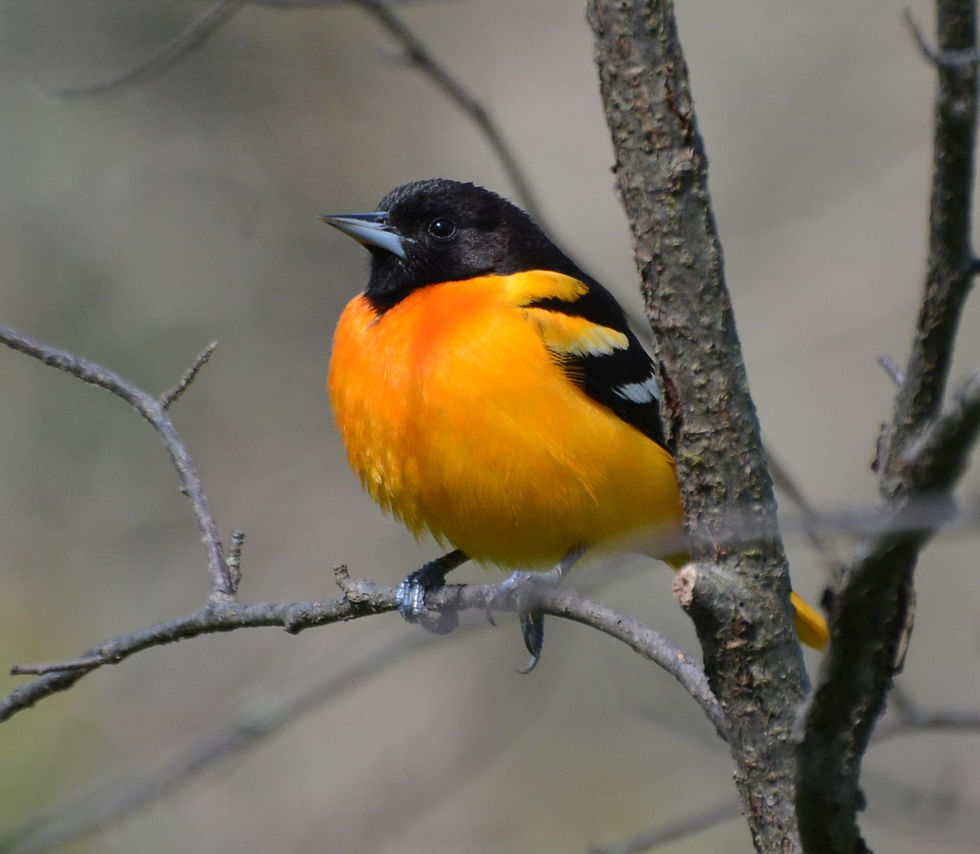
by Geoffrey Carpentier
It’s May, and most of our migrants are back already, setting up territories, finding mates and getting ready to start the next generation of their species. Many of our migrants, most in fact, spend the winter in South and Central America and make the perilous journey, twice annually, north to south then back again in the autumn.
With their return each spring, they do bring joy and colour to our lives, after we’ve enjoyed (?) our own, long cold winters. They arrive hungry and motivated to restart the cycle of life. I wonder, sometimes, how they can recover so quickly from their long migration to refocus on the weeks ahead which, of course, have their own challenges.
So, let’s talk about one of these migrants which, to many, brings a refreshing uplift to their days, the Baltimore Oriole. That’s the gorgeous bright orange and black ‘blackbird’ we see in our trees and oriole feeders.
Wait a minute, did I say it is a blackbird? Well yes, it is in the same family as Red-winged Blackbirds, Grackles and Cowbirds. They have similar characteristics (except colour) in body shape, feeding preferences and behaviour. All belong to the family called Icteridae. Our orioles are called New World Orioles since they live in the western hemisphere. Old World orioles (from Asia, Africa and Europe) have similar names but are not related in any way to ours.
Males develop their most vibrant plumages in their second year, while the females and young males show duller more subdued oranges, yellows and grays. The male’s orange colour is striking and is derived from their diet, as they ingest carotenoid pigments, from fruits like mulberries and serviceberries, which are rapidly metabolized and deposited into their growing feathers. The intensity of the orange, ranging from yellow-orange to deep flame-orange, depends on the carotenoids consumed, with brighter colours indicating better diet and health. So, if you think your oriole is ‘prettier’ than your neighbour’s you might just be right! Occasionally one might even appear reddish in colour if it eats too many red honeysuckle berries, although I have never seen this unique colour plumage.
One would think birds sporting these vibrant colours would be at a disadvantage, as you would presume they would stand out like a sore thumb. On the contrary, once they settle into the nesting cycle, they become less obvious, the song becomes less frequent and they feed high in the trees, becoming almost invisible in the dense tree top foliage. For its nest, the female Baltimore Oriole spends about a week constructing an engineering masterpiece, with little or no help from the male. She weaves a three or four inch deep, hanging sock-like pouch, narrower at the top and bulging slightly at the base, to house the eggs which will soon be laid. Suspended from high tree branches (e.g. maple, elm or cottonwood) for protection, it is constructed from plant fibers, grass, grapevine bark, horsehair, and string, forming a sturdy, flexible "sock" which is lined with soft materials for the eggs. She will even recycle fibres from last year’s nest, if it’s survived the winter, which it frequently does. Finally, she lines the inside of the nest with soft downy feathers, to further ensure the comfort of the baby orioles.
Three to seven eggs are laid, incubated for about two weeks, and then the young are tended to for another two weeks before they finally fledge and complete the cycle of birth and growth.
In addition to fruits, orioles feed on a variety of insects and other invertebrates and will harvest nectar from flowering plants. They are agile feeders who comb the top layers of trees in search of their food.
Orioles are a most welcome and enjoyable part of our ecosystem. Oh, in case you were wondering, these birds are not named after the city in the USA or the baseball team, but rather they were named the ‘Baltimore-bird’ in the 1730s, after Lord Baltimore (Cecil Calvert), the first proprietor of the Maryland settlement pioneer colony in the USA, whose 17th-century coat of arms featured black and yellow/orange colours.
Geoff Carpentier is a published author, expedition guide and environmental consultant. Visit Geoff on-line on LinkedIn and Facebook.



Comments